

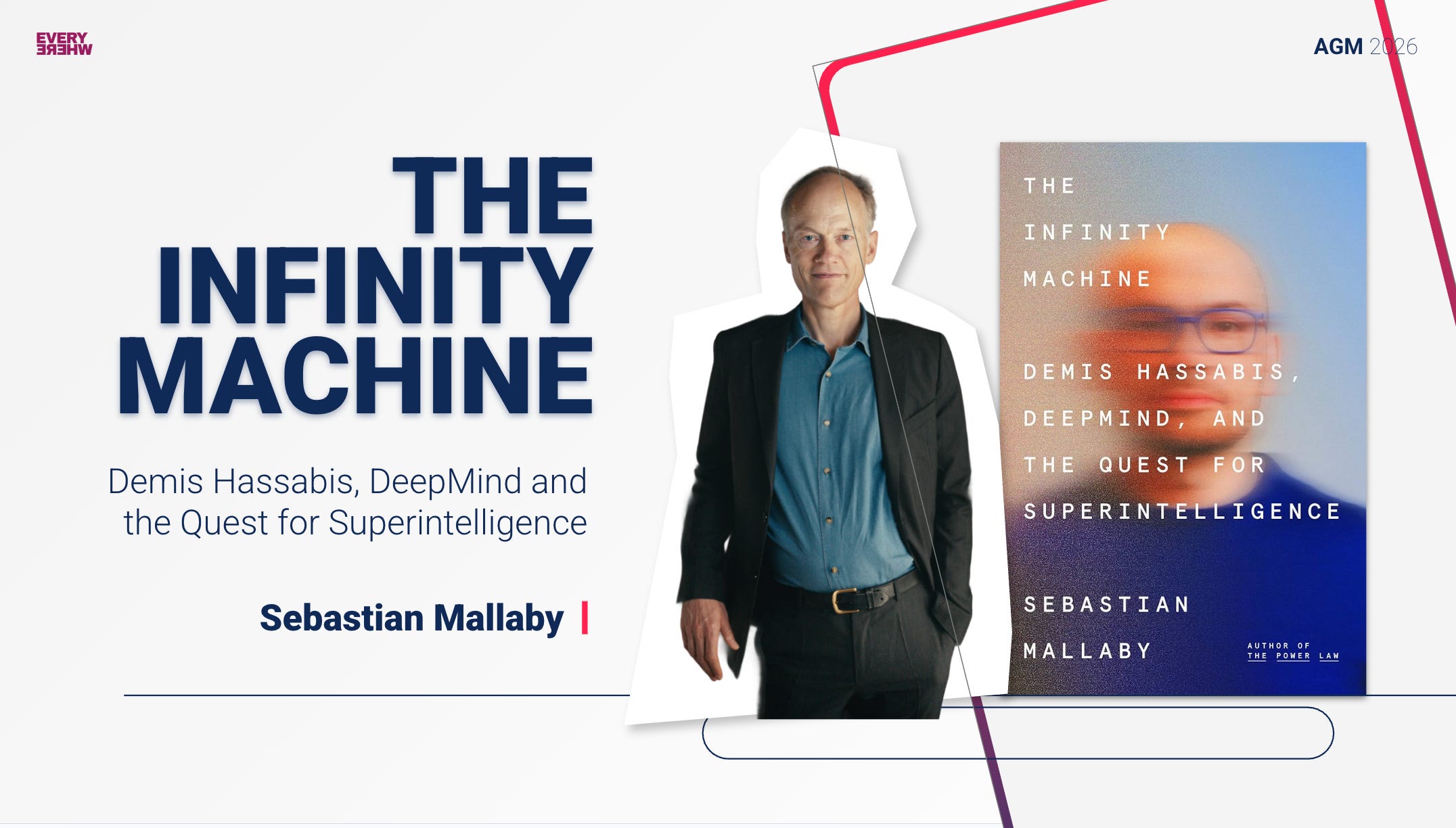
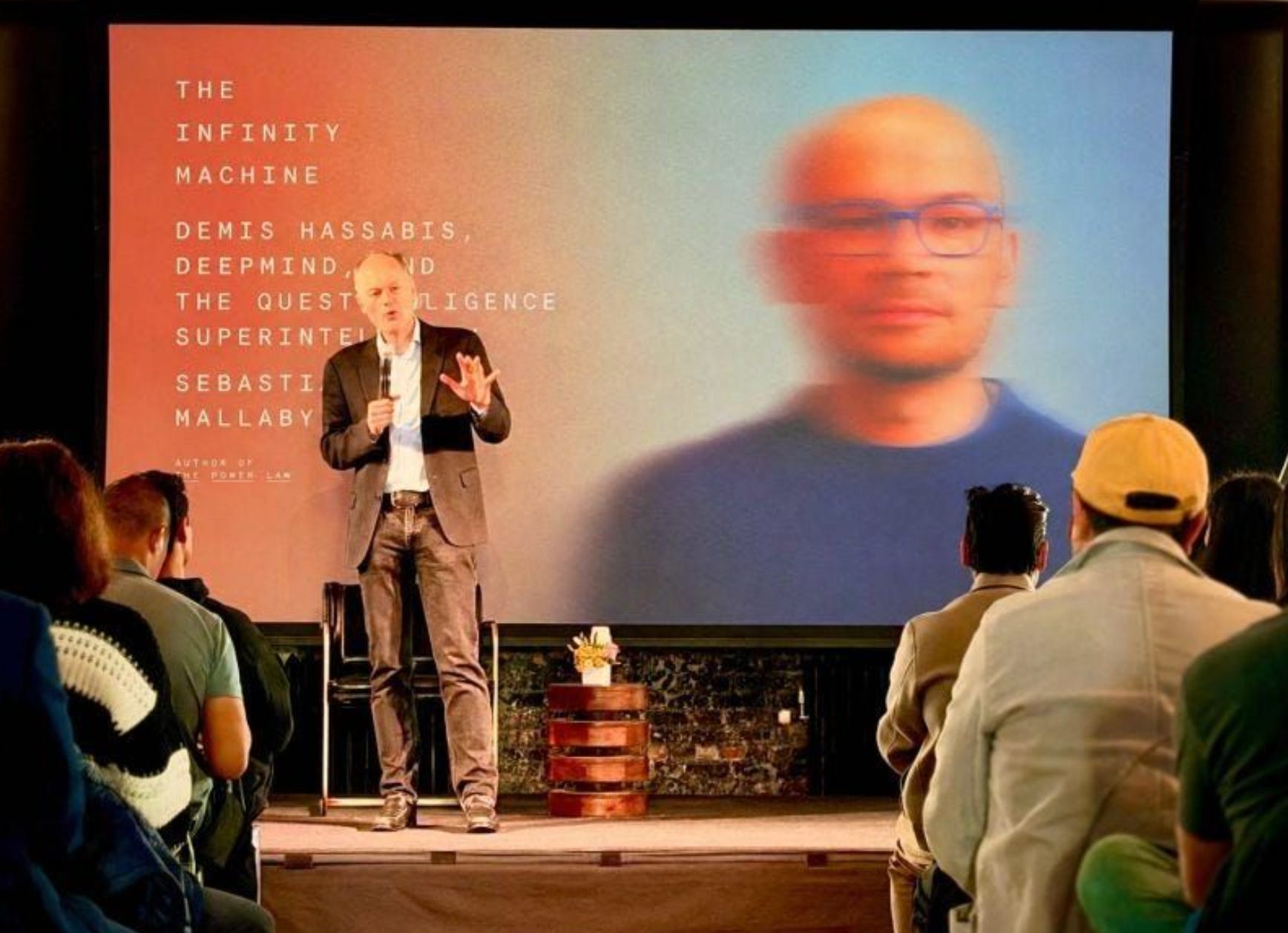
On Thursday April 30th we held our Everywhere Ventures AGM, and we were honored to have six-time author Sebastian Mallaby fly in from London to join us. Mallaby and I met in London’s National Gallery in 2016, when both of our books were up for a Financial Times prize. His book, THE MAN WHO KNEW, on Alan Greenspan, won the Financial Times Business Book of the Year. Mallaby went onto write one of the best books on venture capital, THE POWER LAW, in 2022.
Mallaby’s latest book, THE INFINITY MACHINE: Demis Hassabis, Deepmind, and the Quest for Superintelligence, published in March 2026 with Penguin Press, is not only a biopic of Hassabis, but a broad survey into the rise of artificial intelligence.
In unsurprisingly prescient fashion, Mallaby sought out Hassibis for interviews and a biography nearly a decade ago. Cornering him with logic, Mallaby pointed out that if Hassabis was the top of his field, and if AI would become as transformative as he argued, then Hassabis would himself, become undeniably important. No hiding would change that, so better to get ahead and control the narrative with a book.
Mallaby’s book, however, goes far beyond rote logic. He is a master storyteller, taking us from sun-speckled London cafes to Cambridge quads, chronicling the polymath upbringing of Hassabis. The son of immigrants, Hassabis grew up a chess prodigy and early gaming programmer who went onto become a neuroscientist and AI pioneer.
Hassabis attributes part of his focus on science and technology to a moment in childhood where a wrong-move on the chessboard brought a room of grown men to their feet in critique. Surely there was more to the world than a room full of people watching a child move rooks and pawns across a series of black and white squares.
But chess and designing video games taught him about bounded realities. Great players in chess don’t brute-force all possible moves, they recognize patterns. They compress information and prioritize higher-probability paths. This early observation paved the way to an idea that became reenforcment learning (RL). Similarly, as video game agents came to navigate and optimize actions in dynamic, and increasingly complex bounded worlds, this became a staging ground for early intelligence.
Hassabis is a deeply curious person. Books on philosophy helped him form an opinion on the nature of reality. He internalized the Kantian idea that our reality is an outward reflection of the mind, of human perception, rather than objective truth. That idea drove him inward to study the inner-workings of the brain, neuroscience.
While the early world of AI was deterministic, rules based, Hassibis depth of study of the mind brought him to a more fluid set of ideas around information, and the probabilistic nature of the mind and our perceptions of reality. This rooting in philosophy and neuroscience laid a less conventional path into artificial intelligence. He found like-minded co-creators Shane Legg and Mustafa Suleyman, and together they founded DeepMind in 2010 with a fundamentally different vision for AI.
DeepMind converged disparate academic AI silos. It pushed the idea that rules need not be hard coded in advance. Rather than pre-program intelligence, a machine could learn through repeat exposure, reward, and optimization of its own experience. This paved the way for representative learning and the early generative advances.
In 2016 DeepMind’s AlphaGo played Lee Sedol in the game of Go, a highly complex board game where brute force compute cannot solve for the total number of possible moves. AlphaGo’s Move 37 was a deviation from any human expectation. It was “a one in 10,000 move,” according to commentators. At first it was viewed as a hallucination, perhaps a machine error. But in time as AlphaGo beat the world champion it was heralded to have been a stroke of machine genius, a deviation from expectation or any prior training data, a probabilistic leap, intuition, a move in its own style. Through the course of a million self-plays, AlphaGo had developed its own pattern recognition of possibilities, choices, and style. I actually highlighted this seminal moment for generative AI in my own 2017 book, THE FUZZY AND THE TECHIE.
The rise of AI over the last five years is nothing short of extraordinary. Humans have long harnessed nature, transforming raw materials into new forms. The Greek Technae, the etymological root of technology, means craftsmanship. It means turning raw materials in nature into new forms. In Antiquity, the harp was an example of technae, transforming raw wood and string into beautiful sound. Today we’ve turned silicon and sand into NVIDIA chips powering ChatGPT. We’ve turned a material with low information density into one with high information output.
Mallaby’s book does probe the more dire questions of the day, drawing parallels to Oppenheimer and the Manhattan Project. The desire for technological progress never comes without conscious hesitation as to risks and responsibilities of stewardship. But I choose to lean into the more sanguine threads in this powerful book.
If Hassabis’ philosophical view is that the constituent unit of the universe is information, then perhaps in turning sand and silicon into semiconductors and AI we are in fact repackaging atoms into more information-dense forms. Long past the evolutionary stage of simply building tools, we’re now taking low information-density inputs, and transforming them into radically information-rich outputs. Therefore in our harnessing of nature, perhaps we truly are already expanding the universe.
—
Scott Hartley is Co-Founder and General Partner at Everywhere Ventures, a $100 million-dollar early stage venture capital fund that has backed over 250 companies.