

We’re in the era of the General Contractor CEO.
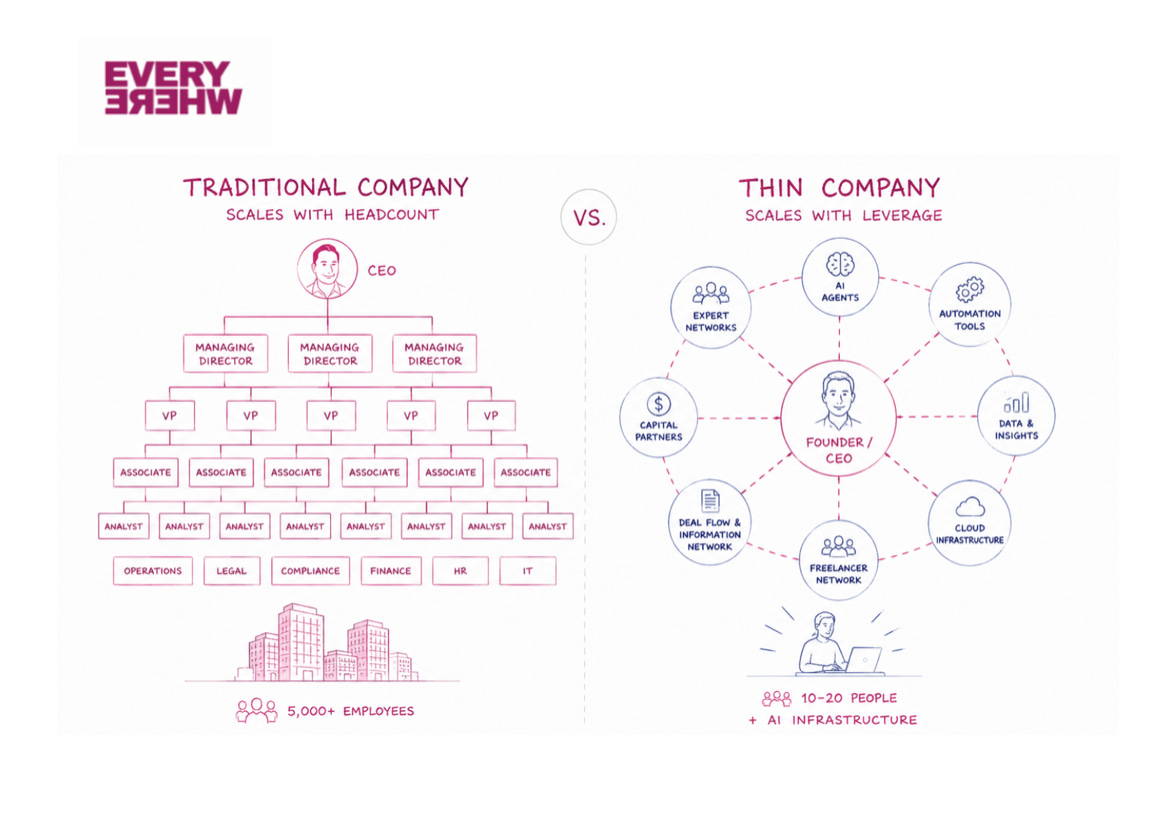
In Asia there’s been a rise of One Person Companies, or OPCs. In the West, many are speculating that soon billion dollar businesses could be single-founder creations, leveraging the output and coordination advantages with AI. I wrote on this idea a few years ago in what I called “The Rise of the Thin Company,” which I first referenced in terms of our portfolio company, Finalis, in May 2023.
The idea around Thin Companies, those enabled largely by AI, builds on the premise that not only can AI can supercharge a founder’s skillset, but also help them dynamically coordinate inputs based on business demands. More like creating a house, a circus or a movie, where skills are assembled and disassembled based on the immediate goals, AI can help in this task coordination and optimization. The company itself need not fully employ everyone to have those output advantages.
CEOs may yet become like General Contractors, bringing together loose ties to achieve organizational objectives, dynamically enabled by marketplaces and AI, rather than needing to bring all of these skills in-house permanently. A GC need not understand every part of the home building process, but they are the coordination authority bringing together foundation, electrical, plumbing, etc. The CEO has long been a lauded position; it’s moving the way of coordination maven.
Federico Baradello, CEO of Finalis, expanded further on this idea. “When we founded Finalis, we asked a radical question: what if the next elite investment bank wasn’t a skyscraper of analysts—but a lean, AI-enabled network of independent dealmakers working from anywhere?” Finalis aims to build the platform that enables 1,000 “investment banks OF one,” rather than a single skyscraper full of 1,000 investment bankers IN one. The reason this is possible, is because the economies of scale, the former advantages of established organizations with regulatory licenses, processes, are dwindling. In other words, you used to have to join a bulge bracket to get your laptop, get your market access, get your licenses, get your capital. No longer.
As the AI-enabled advantages accrue to the independent “General Contractor” CEO or GC-CEO, and to the Thin Company, they soon begin to outweigh the disadvantages associated with bureaucratic scale, working inside the skyscraper.
History repeats as a series of aggregations and disaggregations. The industrial revolution took independent craftsmen and consolidated processes and automation that led to economies of scale, and an inability for a single car manufacturer to compete. Now AI is doing the opposite, pulling on the string that unravels the benefits of being part of a large organization, and providing sufficient advantages to independent operators that they can not only compete, but win with AI.
As Baradello points out, “A Thin Company is lean in headcount but thick in leverage. Rather than scaling with humans, it scales through networks, automation, and intelligent infrastructure.” And so this General Contractor CEO must be adept at assembly, like a movie producer bringing together the components of a film (actors, DPs, gaffers, editors etc), to create art, and stay on budget. These new Thin Company leaders will increasingly be the conductors of AI tools, an agentic workforce, and the fluid human networks when episodic loose-ties are required. Finalis allows bankers to operate independently, but where they are thin on headcount, they’re thick on leverage around deal origination, market making, and info sharing.
I’m not of the belief that every new unicorn will be developed by a single AI-enabled vibe coder in a basement, but I do think we are in a burgeoning period of disaggregation, where AI enabled tools, and loose-tie networks like Finalis will empower far more Thin Companies to compete with bulge bracket players. There will be a break-even where the costs of bureaucracy are outweighed by the AI-enabled advantages of speed, independence, and coordination.
And as to that break-even point, we’re probably already there.
—
Thanks to Michael Barone and Federico Baradello for contributions to this piece.
Scott Hartley is Co-Founder and General Partner at Everywhere Ventures, a $100 million-dollar early stage venture capital fund that has backed over 250 companies.