


Fundraising is hard. For venture capitalists and for founders.
I’d posit that it’s always hard if you’re not on the true frontier of the asset class. Venture capital exists to take bets where other capital markets fail. By definition, it is the riskiest capital for the highest potential returns. It seeks asymmetry.
The notion of being non-consensus and right exists. Or another way of framing it is to be pre-consensus. To be a bit ahead of where the market is moving. This matters both as a founder spending time and resources, and as an investor providing them.
The best investors, like the best founders, exhibit a flexibility of mind. They are adaptable, and move with the opportunity sets. And as the edge of the map expands, so too does this frontier of asymmetric returns. When people complain about the venture capital market, or about the fundraising environment, to me it’s a bit tone-deaf. If you’re not feeling market pull, it’s because you’re not on that frontier.
The frontier is exciting, it’s fast moving, and there is demand for what you’re doing. Rather than cycle on the perceived lack of interest, move to that frontier.
At Everywhere Ventures we designed our LP base, and our investing philosophy to be nimble. I saw on Sand Hill Road the advantages of incumbency, and also the challenges of network half life. As we all age we get set in our ways. We establish habits, heuristics, closely-held beliefs on what works, and what doesn’t. But at Everywhere we wanted a constant pull toward this frontier, so we designed our fund to be predominately founder capital. If the smartest founders were our LPs, we’d constantly be pulled toward what they found most interesting: The Frontier.
I’m not a deep tech investor. I’ve made money in fintech, in logistics, in consumer. But right now the biggest tailwinds are around fundamental structural changes in the economy. When The Internet came about, PC investors lamented the lack of capital, because the smartest money had moved to the frontier. When the social web came about, eCommerce investors labeled it a fad, and lamented the erosion in capital availability. Then there was the iPhone, SaaS, sharing economy, the globalization of local on-demand services, web3 and blockchain, and now AI and space. Some trends are transitory, not secular. And the tropes about VCs as lemmings chasing the latest shiny objects are not without some truth. But other changes are structural, and not transitory. PCs. The Internet. Mobile. SpaceX, and the explosion of AI.
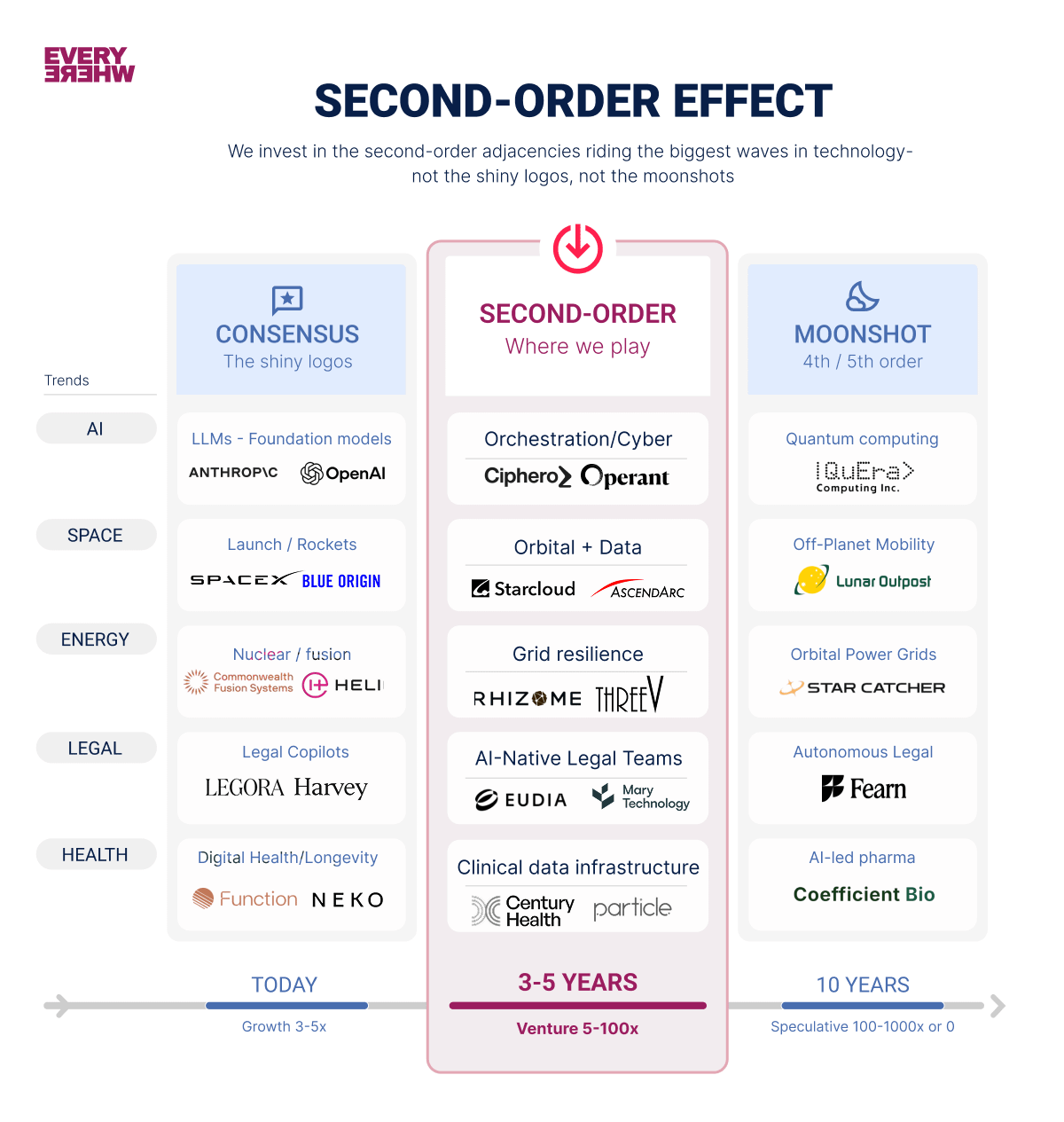
We articulate our thesis not by sector-focus, and not by business model. We articulate our interest around this frontier, and backing what we call “Second Order Effects.” The secular changes create knock-on effects. Not every good company is priced to the moon because it is the first-mover in a new space, with an A-plus networked team. Some of these exist, and for every one there are 100 fast-followers riding slipstream, harnessing the velocity of that new frontier expansion, and in the tailwinds.
We see these opportunities today around a number of areas:
Embedded AI in healthcare and fintech, where regulatory hurdles are hard
Orchestration layer AI for model cost and output optimization
Infrastructure around the new space economy, and future of connectivity
New energy systems and grid resilience to support greater compute
Egocentric data collection to inform VLAs and humanoid robotics
Investors aren’t seeking incremental ideas, nor are they all playing for moonshots with 15-20 year time horizons. In the middle is a seam of opportunities we’d classify as second order effects. These opportunities harness secular tailwinds, and are pushing the edge of the map, but aren’t so far off the map so as to be moonshots.
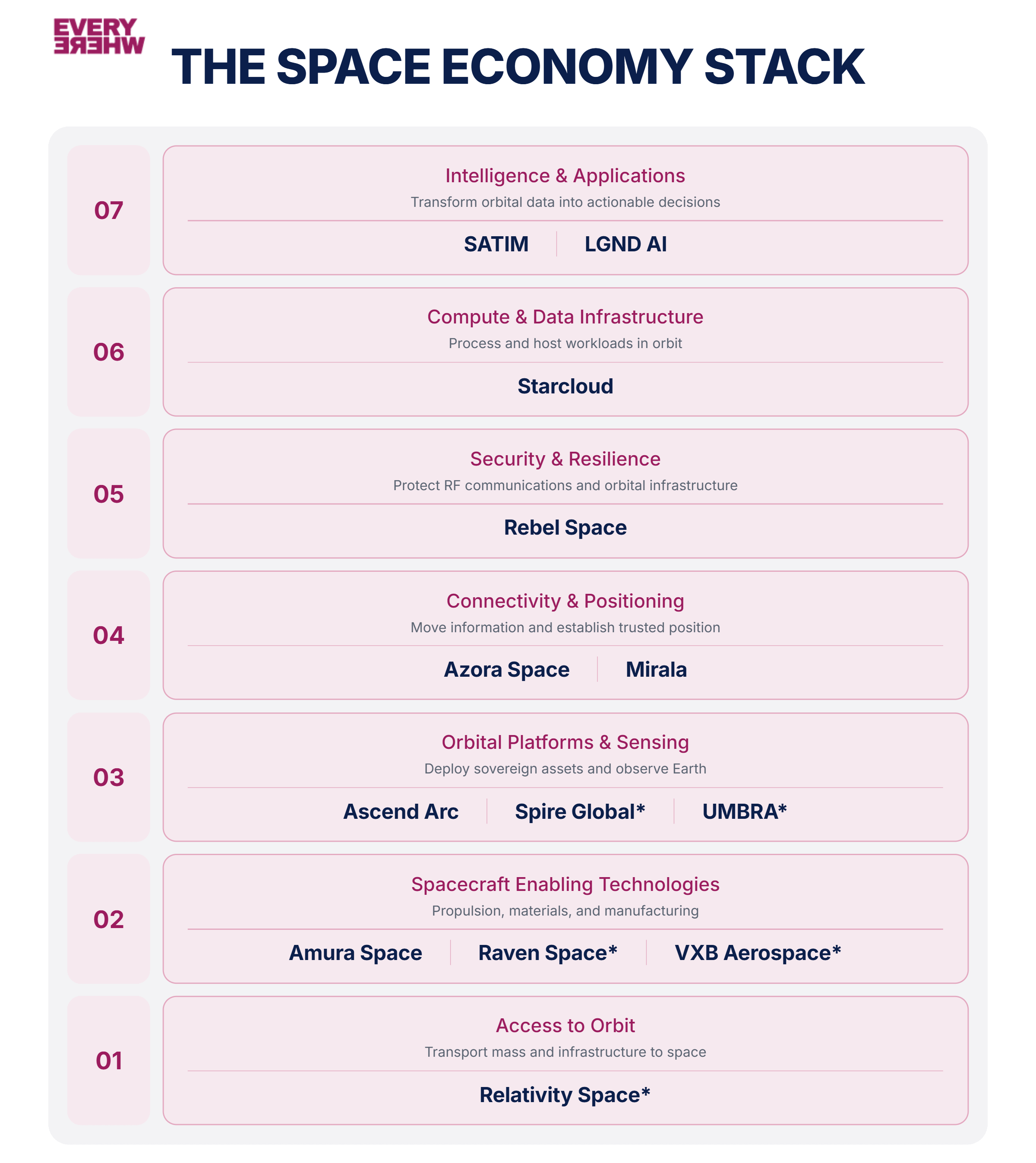
Taking the example of space, there are the obvious consensus bets like SpaceX, and then there are a number of offshoots and second-order effects. Access to orbit and launch alternatives then require spacecraft enabling technologies (satellite bus systems, mobility solutions, power and propulsion systems, reaction wheels). The diminished cost per kilogram to space mean more orbital sensing and compute platforms become economically viable. These in turn lead to greater data collection in space meaning more need for in-space backhaul, and space-to-ground communications and navigation enabled by alternative-PNT and optical channels. Greater transference of data means a greater attack surface for cyber attacks, so the need for defenses and spectrum attribution becomes paramount. On top of all of this data collection exist a number of layers for analytic integration, and marketplaces on top of installed but under-utilized assets. While there are perhaps even longer-term third-order effects like in-space assembly and manufacturing (ISAM) and materials science, pharmaceutical and biological developments, these are farther out to us, as they require fluidity in robotics, and reduced down-mass costs.
Again, drafting off SpaceX, here are seven layers of second-order effects, and a list of opportunities for founders, where investors are heavily drafting off tailwinds, and the belief that this new frontier is a multi-trillion dollar emerging economy.
Instead of engaging in the morass of negativity around what’s changed, it is your job as a founder or an investor to disengage with the dialogue, and find the frontier. It doesn’t have to be space, and it doesn’t have to be deep tech. But it does have to be informed by the zeitgeist, and your belief in where the world is fundamentally going. Because I promise you venture capital is not dead. The frontier has just moved, and the faster you reorient yourself to find it, the more relevant you will remain.
—
Scott Hartley is Co-Founder and General Partner at Everywhere Ventures, a $100 million-dollar early stage venture capital fund that has backed over 250 companies. He has been investing in frontier second-order effects since 2011.