


In Brooklyn, a block off the waterfront on Broadway, there’s a Williamsburg staple called Diner. One of its most endearing features is there are no QR code menus, no digital ordering. Analog only. Instead, the waitress usually slips into the booth with you, sharpie in hand, and jots down the options right onto the white butcher-paper tablecloth. Oysters, a market crudo, their famous burger, scribbled in shorthand.
Along with the waitress, I sat across from Matias Corea, a Catalan polymath designer who founded and sold Behance to Adobe for $150 million before diving headfirst into jazz and riding motorcycles across continents. He’s written the coffee table books about transcontinental adventures (and wipe outs) to show for it.
I’d come off a red eye from who-knows-where, and at 8pm Matias and I were just beginning our night. Three hours of philosophy, politics, design, jazz, motorcycles, and startups later, we had commandeered the sharpie and were trading ideas on the tablecloth, and we’d finally converged on tech. The food was gone, the Martini glasses had been pushed aside into a jumble of clinking glass, and ideas were flowing.
Matias frantically penned a series of short lines followed by long lines, or the outliers. “This is commercial” he said with conviction, staring at me over his black rimmed glasses, “and this is art,” he said pointing at the outlier lines protruding among the others like skyscrapers. “Great art, genius; it stands out.” As we riffed on this idea my mind went to venture capital, my work and lens on the world for the past 15 years. “What’s interesting I said, is a lot of those outlier lines know each other. Genius trades notes, and when you amplify that you get MASSIVE signal.” What we were thinking about was collaboration, great bands, great artists. But also, great entrepreneurs. Knowing what’s true signal is access, and it matters.
At Everywhere Ventures we’re a community of founders first, and a venture capital firm second. Our hundreds of limited partners, or investors across our funds, are themselves founders. They’re the spikes in the graph. They’re the ones who left a commercial life behind to build art, to solve a problem, to go insanely deep on an idea or a sector. Great art, like great tech, is somewhat anarchic. Iconoclastic.
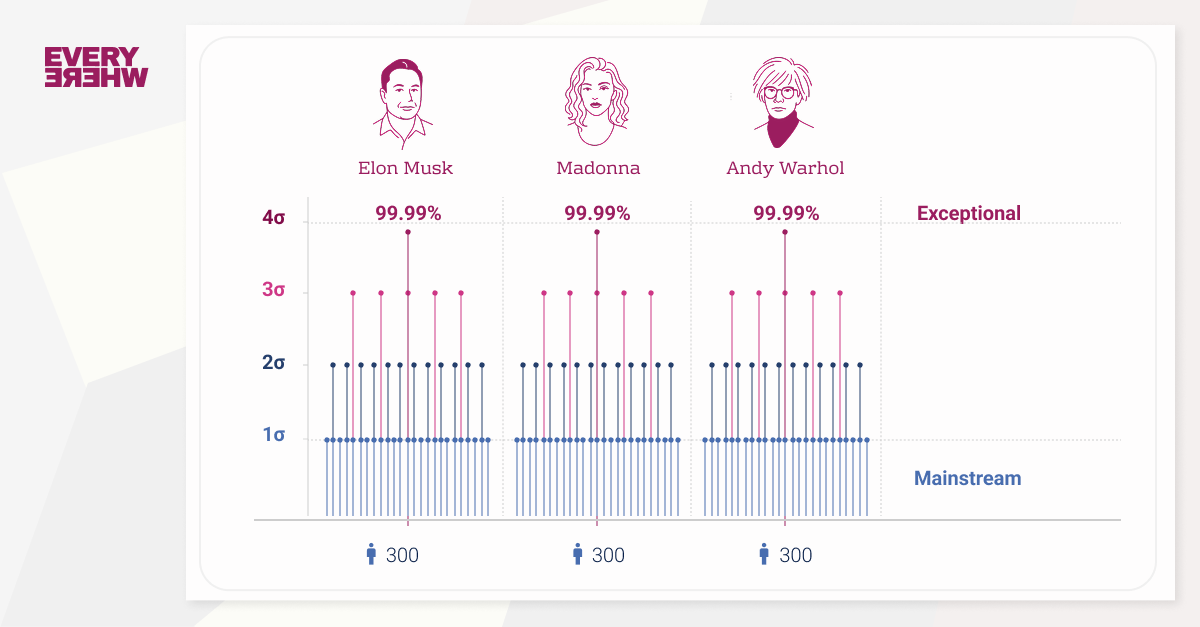
Spikiness does not mean you went to Harvard, nor that you worked at McKinsey. These are not points of salience; these are points of mainstream adoption and are antithetical to what we’re talking about. Greatness in some area, or spikiness, isn’t’ about privilege. It’s about patina, a refinement, a rock in the tumbler until every edge is worn down and there’s an endurance, and a grittiness that shines through in specific areas. It could be Madonna or Andy Warhol or Elon Musk. It’s also about charisma and authenticity, being so true to your vision that you’re able to step away from the “commercial” world, and be anarchic. And the amplitude of these spikes are signals, and when they’re multiplied in collaboration, there are compound effects. Charisma, grit, patina, authenticity, conviction, these are compound signals.
As we scribbled and talked, I began to think about how any one of us can manufacture luck. Luck is a byproduct of listening to intuition, and intuition is pattern recognition of what stands out from the status quo melded with a viewpoint on the world. When those things stack up, and when we truly listen, there is some signal in the noise.
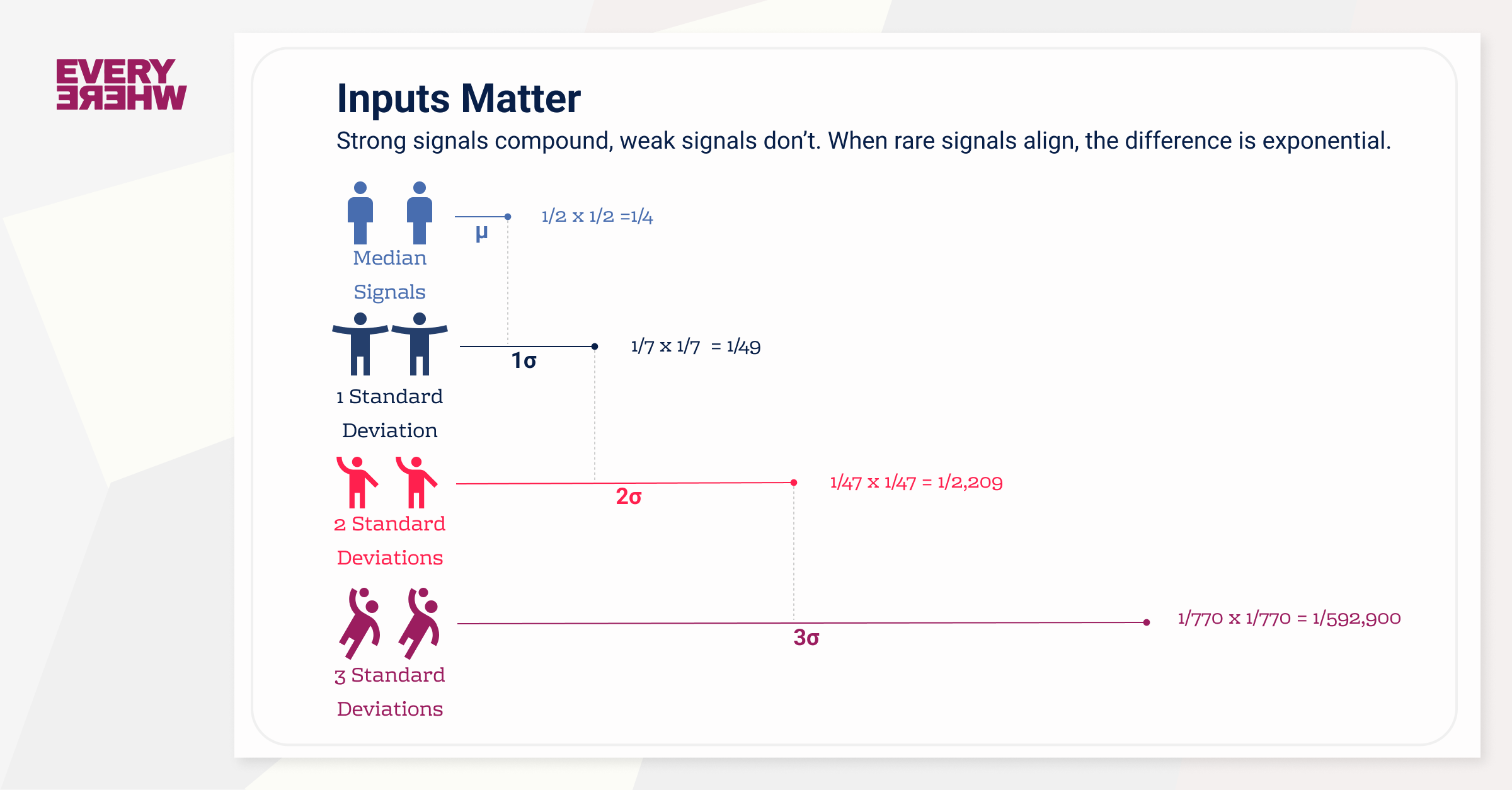
Pretending to do statistics, we started discussing Gaussian distributions, or bell curves. The median is the midpoint, and also the mean, or 50th percentile. Multiplying two signals at the median is like multiplying a ½ perspective by a ½ perspective. There’s not much advantage or compounding effect. But when you start thinking about what it looks like to multiply two inputs that are one, two, or three standard deviations away from the mean, you start to see the impact of compound spikiness or signals in noise. You start to see that outlier signals really compound.
If we talk to a dozen companies in each problem area or sector, and we diligence those ideas by trusting signals we deem to be a few standard deviations out from the mean on the curve in that domain, we start to be able to amplify signals. We start to see things really standing out clearly as spikes within the graph, as extreme right points on the bell curve. I often say, “if you’re going to get heart surgery, you should ask a heart surgeon who would do their surgery.” That’s a compound signal.
Alfred Lin at Sequoia talks about how they talk to 1,000 entrepreneurs for every one check that they write. They look for exceptional founders or CEOs they deem to be not average, not good, not great, but outliers. These are 1/1000 builders at the forefront of the problem they’re solving, tech they’re building, or idea they’re chasing.
These are true “artists” as Matias put it. And yes, CEOs are also building companies to achieve sustainability, meaning they generate profits, value, and outsized wealth creation, so to call them “non-commercial” is disingenuous, but that’s the word we’re using. They’re non-commercial in the “play the game,” societal sense, of ticking boxes and status quo. These are game changers, category creators, dreamers and builders.
As an entrepreneur, as an artist, as a venture capitalist, how can you listen to the inputs and separate signal from noise? How can you refine your inputs such that everyone around you is a polished stone in their own zone of genius, and then how can you learn to categorize those inputs to know which to listen to when? If you can do that, I’d argue, you can start to refine signal from noise, and surround yourself with more amplitude around big ideas, and you’re going to create your own luck.
We didn’t, on the face of it, set up Everywhere Ventures for this purpose, but we did have a hypothesis that static partnerships don’t scale with dynamic innovation. Innovation is a frontier, a moving target, an organic set of ideas that changes with the tools of the day, the current zeitgeist, and so the only inputs that can keep pace are those that are dynamic and evolving with that frontier. We raise money from LPs who are founders because we think the value is in their voice, not their dollar. And we listen to them on inbound deals and in diligence, and in how we refine our own perspective on big opportunities and markets. Signals as building blocks.
If you’re a founder the best way you can pitch a VC is by getting an introduction from someone they deeply trust as an expert, and a signal, in that zone of genius. This isn’t about an insider’s game of access, nepotism, or where you went to school; it’s about putting yourself at the center of that spikiness where every signal is telling others to listen, to lean in, and maybe to write that 1,000 check. It doesn’t matter where you live on the map, or what background you come from. We can all build our own luck.
Build yourself around your areas of passion, and surround yourself with the highest value, most respected signals in that space, and good things will start to happen.
—
For more, check out our Founder Spotlight series at Everywhere Ventures. And special thanks to Michael Barone and Amelia Muro Garlot on the graphics.
gotta love network effects