

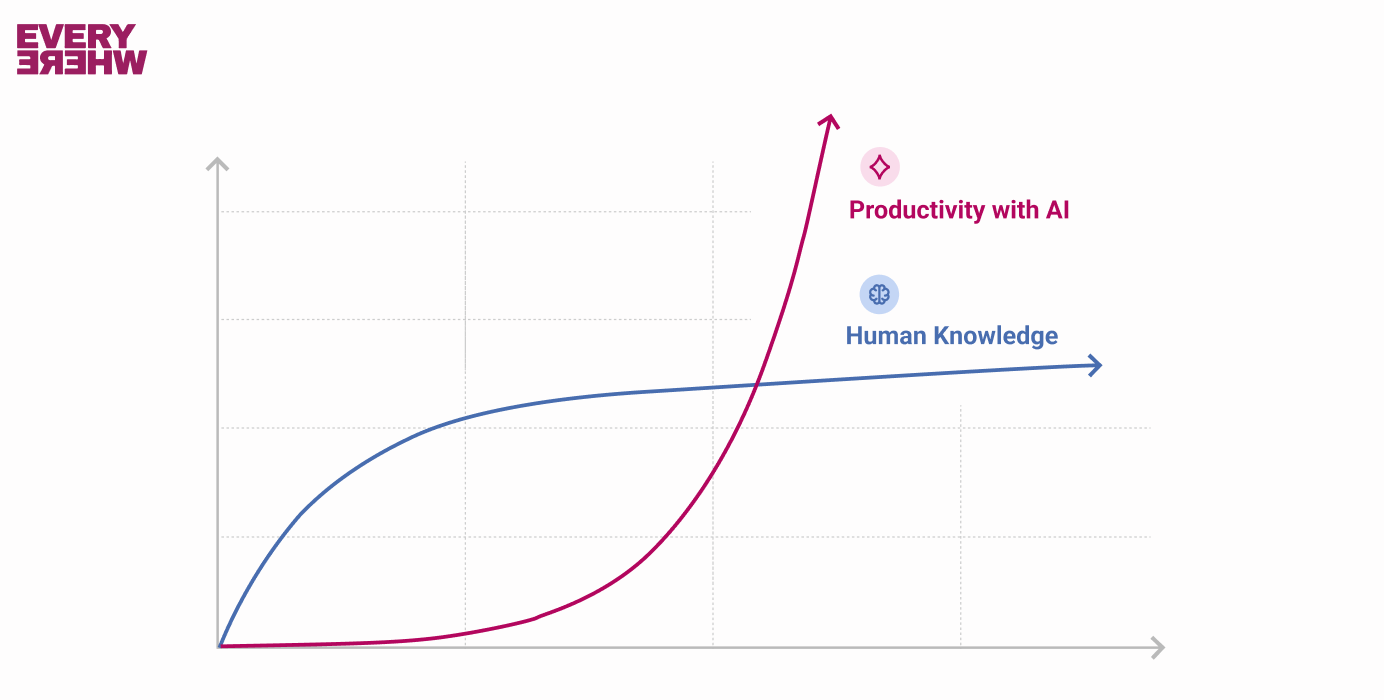
The promise of artificial intelligence is exponential. It accelerates productivity, compresses time, and allows us to navigate vast domains of information with unprecedented speed. But beneath that curve of acceleration lies a quieter dynamic: the substrate on which AI operates—human knowledge—is not expanding at the same rate. AI systems are trained on data, and data is, by definition, historical. It is what has been written down, recorded, and digitized. In that sense, AI does not engage directly with reality—it engages with a representation of reality, a subset, of a subset, of a subset of the lived human experience.
It operates on the map, not the territory.
And the map, however vast, is incomplete. Human knowledge has never been confined to what is recorded. It lives in experience, in intuition, in culture, in tacit understanding—what is practiced but not formalized, felt but not fully articulated. These are not edge cases; they are the frontier of human experience. When we equate the digital corpus with the totality of knowledge, we collapse the territory into the map. AI, for all its power, can only see what has already been captured.
This creates a paradox. As AI increases our ability to process, recombine, and optimize existing knowledge, it gives the appearance of accelerating discovery. But if the underlying domain of lived, human-generated knowledge is not expanding—if we are not continually pushing into new experiences, new observations, new forms of meaning—then we risk entering a recursive loop. AI generates outputs from the past; humans consume and refine those outputs; and those outputs become future training data. The system begins to feed on its own reflections. Progress becomes increasingly efficient navigation within the map, rather than exploration of the territory beyond it.
This tension is not new. As Tim Wu observed as far back as 2018, modern society has long been oriented toward efficiency—toward removing friction, compressing time, and optimizing the human experience. From industrial assembly lines to the imagined futures of The Jetsons, we have consistently equated progress with convenience. The moving sidewalk becomes a metaphor for a broader ambition: a life in which effort is minimized and everything flows seamlessly. AI represents the apex of this trajectory.
But to be human is not to be optimized. Efficiency is a property of systems; exploration is a property of people. The essence of human progress has never been the elimination of effort, but the expansion of the unknown. We are the species that leaves the map—that ventures into ambiguity, that generates new knowledge not by recombining what exists, but by encountering what does not yet have language or taxonomy.
Throughout history, progress has been driven by those willing to sail past the edges of the known world. Ferdinand Magellan did not optimize existing trade routes—he circumnavigated the globe. James Cook did not refine existing maps—he redrew them. Ibn Battuta did not summarize known cultures—he immersed himself in unfamiliar ones, denoting his 75,000 miles of travels in his epic work The Rihla. These were not acts of efficiency; they were acts of expansion.
The same is true of innovation. The most consequential builders do not simply stand on the shoulders of giants—they climb onto those shoulders and then step off into the unknown. Nikola Tesla imagined electrical systems that did not yet exist. Steve Jobs reframed the relationship between humans and machines. Elon Musk pushed into domains—electric vehicles, private spaceflight—that were widely considered impractical or premature. These are not incremental optimizations of the map; they are expansions of the territory. Today we see this in our own portfolio in companies like Starcloud who are pushing the frontier of what’s possible by moving data centers, and more notably inference, into space, helping NVIDIA pioneer new chipsets architected to optimize space-to-space workloads for off-Earth optimizations.
This is, fundamentally, the work of venture capital. At its best, investing is not the allocation of capital to known outcomes—it is the identification of individuals and ideas operating at the boundary of the map. Great investors are not simply pattern matchers; they are frontier detectors. They look for the non-consensus, the contrarian, the ideas that do not yet fit cleanly within existing frameworks precisely because those frameworks lag reality. The goal is not to fund what is already legible, but to recognize what will become legible. The goal is not to be contrarian for its own sake, but to back explorers pushing the frontiers of new territory, building the map of where humanity is perhaps already going, but more importantly, desires to go.
In an AI-driven world, this role becomes even more critical. If AI excels at navigating and optimizing within the known map, then the highest-leverage human activity shifts toward expanding that map. The entrepreneur becomes an explorer—someone who ventures into domains that are under-explored, misunderstood, or entirely new. And the investor becomes a backer of expeditions, placing bets not on certainty, but on the possibility that the territory itself is larger than we currently understand.
This reframes the relationship between humans and machines. AI can be an extraordinary engine for exploitation—for extracting value from what is already known. But exploration remains a deeply human endeavor. It requires curiosity, risk tolerance, imagination, and the willingness to be wrong. It requires stepping into spaces where data is sparse, where signals are weak, where there is no clear precedent to follow. And today exploration can also be done with the aid of AI, leveraging new technologies under human stewardship to push and define the edges of the map.
The risk is not that AI will outpace us, but that we will allow ourselves to become overly reliant on what it can already see. The opportunity is to use AI as a tool in service of exploration—to extend our reach, to test hypotheses more quickly, to navigate the known world more efficiently so that we can spend more time at its edges. To be human, in this context, is not to compete with the machine on efficiency, but to complement it through exploration.
We are not just explorers on the map. We are authors of the territory it defines, and as venture capitalists and entrepreneurs, we’d do service to ourselves to remember this orientation as explorers stewarding time and capital in the service of pushing the edges of the map, where new knowledge and value can be unlocked.
—
Thanks to Rishi Jaitly and the Virginia Tech Leadership in Technology program for providing the basis of discussion leading to this post, and to Amelia Muro Garlot for her excellence in graphical storytelling and design at Everywhere Ventures.