

Two years ago I made the argument that AI was creating a bifurcated strategy in enterprise leadership. Companies were forced to choose one of two paths:
Strong: Maintain inputs, generate greater output with AI amplification
Skinny: Truncate inputs, generate the same output on AI efficiencies
Ten years after publishing my book, THE FUZZY AND THE TECHIE, I still get invited once a quarter to speak to corporate audiences about the evolution of technology, and importance of human skills, soft skills, in the stewardship of that technology toward the gravest problems. This story has evolved from one of spotting bias in big data, providing context to code, into one that revolves around human skills in the era of AI. Today AI proliferation has further deepened the leadership trade-offs around AI adoption for efficiency gains and cost cuts, weighed against AI adoption for growth and output expansion through human labor amplification.
In 2017 I gave the example of radiologists, whom many at the time claimed would be “out of a job,” to highlight where this “skinny” myopia overlooked the reality that AI would not obviate all radiology jobs, but bring costs down, expand the demand for MRIs, and fuel a massive boom in radiology where there might be net new demand. In those ten years since the book we’ve seen the rise of Prenuvo, Ezra, EverLab, Function Health, Axo Longevity, and a number of players bringing this reality to fruition. While many feared a “skinny-only” outcome, what prevailed was predominately strong. Inputs remained relatively fixed, meaning not all those radiologists became unemployed, output expanded, costs came down, and demand skyrocketed. Today there are more radiologists than there were ten years ago. Opposite of expectation.
As AI efficiencies brought radiology costs down, and expanded demand, radiologists were pushed farther out onto the frontier of the “map,” working on edge cases that AI could not fully automate. What was truncated were not radiology jobs, but the rote tasks within radiology that made the work inefficient. By streamlining these rote tasks with the aid of AI, the time required to perform and interpret a scan went down, and thus radiologists were able to perform more scans in the same unit of time. This expansion in output on the same inputs (Strong), drove costs down. Relatively price sensitive consumers were suddenly able to afford something previously inaccessible, and so demand expanded, yielding a much larger than expected consumer market.
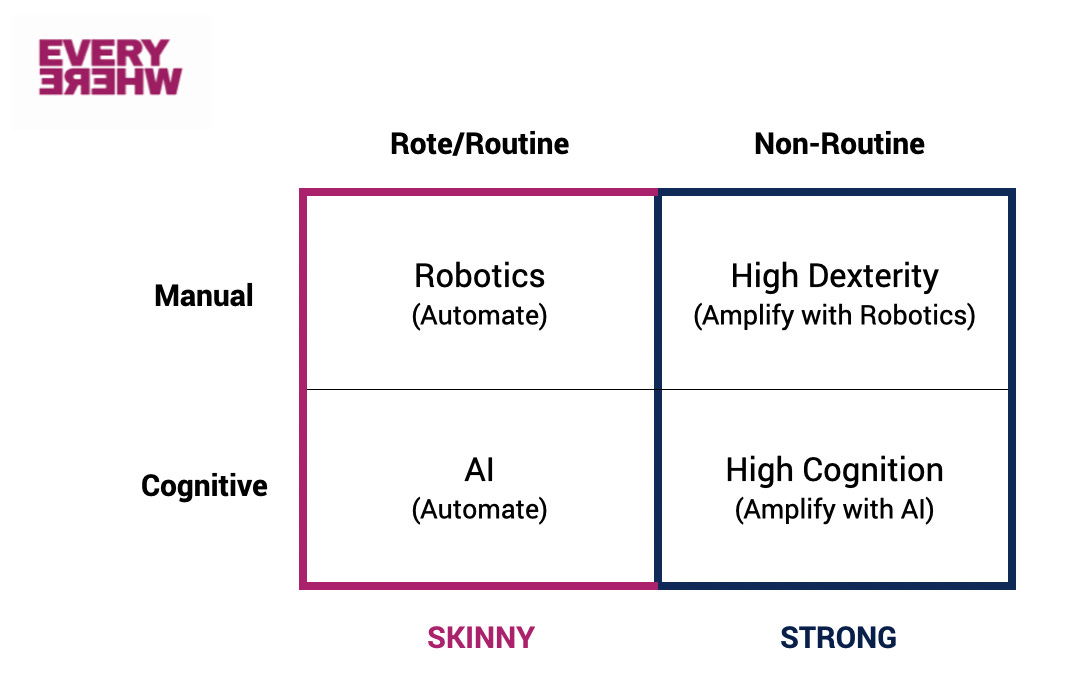
In every organization there are many jobs. And Jobs are comprised of individual tasks. Those tasks break down along two vectors. Tasks can be manual or cognitive, and they can be routine or non-routine. For rote manual tasks, robotics can substitute for human labor. For rote cognitive tasks, artificial intelligence can enable significant gains. Within these subsets of tasks, like routine radiology, AI can yield efficiency gains that allow leaders to make a choice. If they opt for “Skinny” they could cut inputs, and perhaps still generate the same output. But in a competitive market where your competition may not do the same, “Strong” is often the preferred choice, where inputs are maintained or only marginally cut, and AI-enabled outputs drive growth. In the case of radiology, given the relative price sensitivity of consumers, this growth actually yielded expansion in market size, demand, and net new jobs were created.
In practice, there are adoption timelines for technological substitution, and even in a “Skinny” scenario where a company chooses to cut human labor for machine, there are, in nearly every case, situations in which a human steward is still required. Technological capability still belies the organizational complexity of adoption, so the headlines will always front-run the reality we experience as employees.
For most jobs, however, a different story exists. Most jobs contain a high proportion of non-routine tasks that require creativity, collaboration, communication, and these are jobs wherein AI adoption is not an ultimatum, but a serum for higher productivity. These are the domains of “Strong” AI adoption, where AI might rather be called IA, or intelligence amplification. Human skills are enhanced, not obviated, and AI pushes these employees out of the rote and routine tasks into more human capabilities.
Omar Haroun, CEO at Eudia, talks about a “Pareto Compression,” where the old adage of 20% of inputs driving 80% of outputs is being compressed. In this new world, expertise is rewarded exponentially, with perhaps 5% of inputs driving 95% of outputs. This doesn’t mean we’re all doomed. What it means that in every role, every job function, humans will be pushed into that zone of genius, that 5% where what they do truly counts. In the case of radiologists, it’s the interpretation of non-routine cases, more patient engagement, an expansion in the need for soft skills, coordination, and communication. Pareto Compression does not mean a compression in the number of people to do the job; it means a compression in the task-sets within every job, pushing every performer to higher, more satisfactory marginal work, on top of AI. Like the radiologists, it can expand demand, and push the role to the frontier of accretive human capability. In other cases, it doesn’t mean everyone must become an expert; on the contrary, it broadens the base of who can do the job, and opens doors.
In a competitive environment the choice of Strong vs Skinny is not an ultimatum, or a zero-sum choice; it is the requirement of every organization to dive deep into jobs, identify tasks, and choose where to apply “Skinny” and where to apply “Strong.” Most organizations will have to do both by trimming non-routine tasks with robotics and AI, and by amplifying non-routine tasks with these extraordinary new tools. The world of AI adoption is one of rote task elimination, a broadened base of who can do the work, and a Pareto Compression of expert work amplified significantly. The error is in thinking that AI adoption is only one zero-sum choice; in fact, it is many, and in most cases leaders will find needing to have a “Yes, And” conversation about cost cuts and Skinny, and growth drivers and Strong, a widened funnel of whom they can employ, and a premium paid for true domain expertise and depth of experience.
—
Special thanks to David Travers and the ZipRecruiter leadership team for inviting me to speak on these and other themes in April 2026, and further refine the ideas. For more about Everywhere Ventures, subscribe to our 40,000 person newsletter.