

What is a robot except hardware enabled with artificial intelligence? What is space except an extremely remote robotic system? We ought to recognize that our new AI-led world is accelerating space and robotics, atoms, and anyone myopically only focused on LLMs and terrestrial applications, bits, will miss half the value creation coming out of this transformative wave of AI.
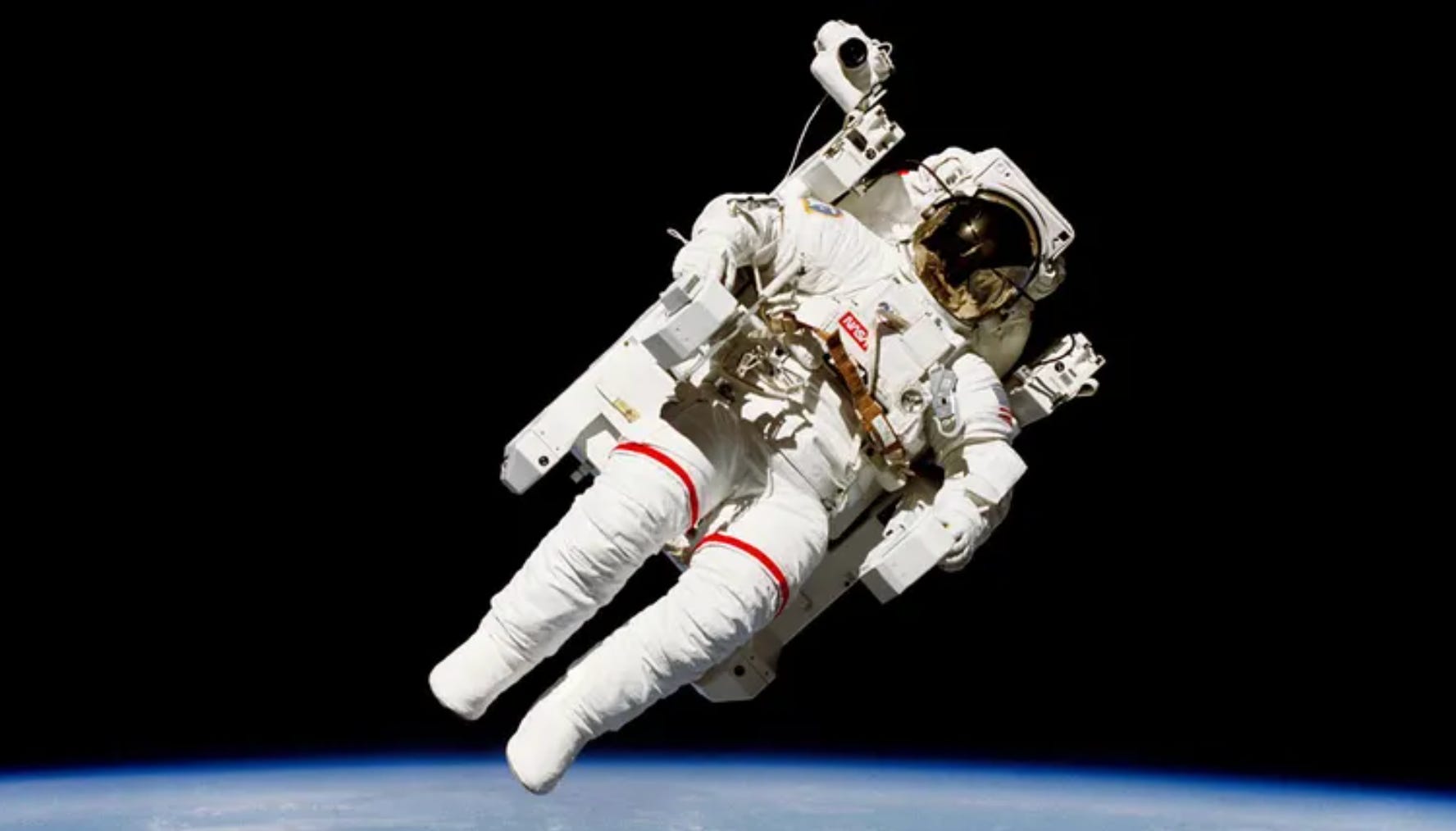
I’ll admit, I’m someone who’s been exposed to NASA since the 1980s, and have a little sister named after astronaut Anna Fisher. I grew up with framed Apollo 11 sketches signed by Neil Armstrong in the hallway, and baby dedications from Bruce McCandless on his 1984 Shuttle Mission STS-41-B framed next to soccer trophies. My childhood home was one as infused with space as it was an obsession with Steve Jobs and Apple, someone who later became my college graduation speaker.
I’ve been an investor in space technologies since 2014, and through that time have had the chance to work with companies like Spire, Relativity, Umbra, Ascend Arc, Mirala, Starcloud, Azora, and many others, across LEO and GEO, Earth Observation (EO), Launch, Signals Intelligence (SigInt), Synthetic Aperture Radar (SAR), Satellite Communications (SatCom), alternative precision navigation and timing (PNT) systems for alt-GPS, and optical ground stations. I delivered a keynote address to 3,000 people at the 2018 GEOINT Conference, and in 2020 I wrote about how Elon Musk was building the “Railroad to Space,” not too dissimilar from how Leland Stanford connected the American West with the trans-continental railroad in 1869. The knock-on effects, and new economic power off of those rails, transformed our economy.
The newfound velocity around hardware today is being driven by a few factors, but particularly artificial intelligence as the base-layer accelerant. AI is powering hyper productivity in software, and we’re all aware of Anthropic’s Claude, and the vertical specific applications and many agentic incarnations. But this same productivity accelerant is additive to hardware development as well. Companies like VXB Aerospace are helping accelerate the ideation to production speeds for all types of complex component manufacturing around aerospace and defense.
The defensibility of software as a service (SaaS) is under perennial threat, with founders and investors alike asking the existential question, “Won’t Claude do that?” And so many are impelled by the dual tailwinds in hardware around increased prototyping and production efficiencies through AI modeling, as well as the perceived moat around building a physical product that can’t be immediately obviated.
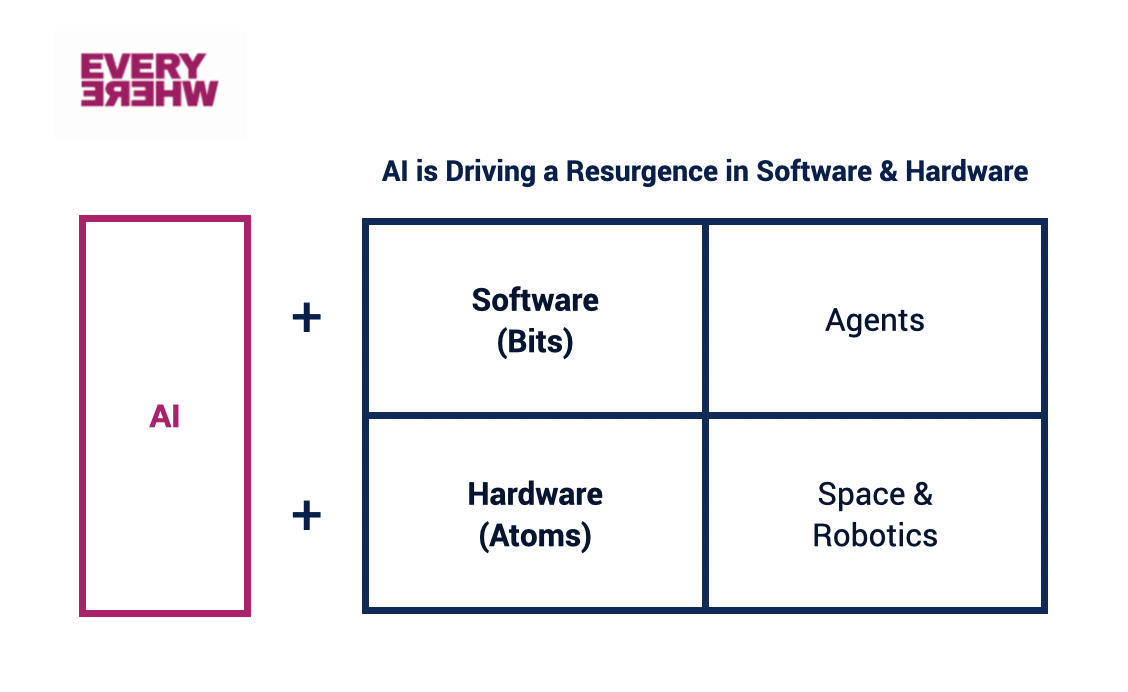
The 2026 hardware resurgence is being driven by a:
Proliferation of talent spin-outs from Tesla, SpaceX and others
Perceived defensibility of a product vs merely a software service
AI-enablement layer driving cost-efficient prototyping and development
Renewed defense and government procurement system focused on commercial partnerships, fast-tracking contracts, and re-domesticating manufacturing. This is challenging the notion that “hardware is expensive” (meaning dilutive)
Compounding of hardware components becoming more modular, akin to what happened with software stacking, SDKs, and the explosion of APIs
To Peter Thiel’s delight, innovation is finally moving to atoms, not just bits. In 2013 he and Marc Andreessen faced off at Milken about this exact topic. The nuance however, is it’s probably those bits that are driving the change in atoms. Both right.
Each week I see a former SaaS fund post their latest deal in robotics, space, or physical infrastructure. We need not be surprised. If anything, those who are doing this have recognized that the venture frontier has shifted. Years ago I wrote about how lived experience helps us build patterns and heuristics which inform frameworks. Our frameworks are backward-informed and time-delayed. Frameworks necessarily lag the reality we already live in. So rather than root in yesterday’s outdated thesis, or point fingers at some manager we deign to think has gone “off thesis,” we might accept that AI is driving change in not only software, but hardware as well, and markets like space, robotics, and physical infrastructure are no longer “deep tech.”
These are categories impelled by AI, fueled by talent spin-outs, and compounded by the very popularity of hardware itself. As more founders begin building hardware, component stacking becomes even easier, more modular, more assembly-block. Just like SDKs and APIs made app development an assembly project in 2008, with the Apple iPhone as distribution, today commoditized platforms like K2 make the raw satellite ingredients accessible, and SpaceX offers distribution just like Apple.
AI is driving the most significant technology wave since the Internet, and we’d be remiss to overlook hardware founders as major beneficiaries of AI. While Claude may erode software moats in SaaS, it might also bloom 1,000 flowers in hardware.
—
Scott Hartley is Co-Founder and General Partner at Everywhere Ventures, a $100 million-dollar early stage venture capital fund that has backed over 250 companies.