


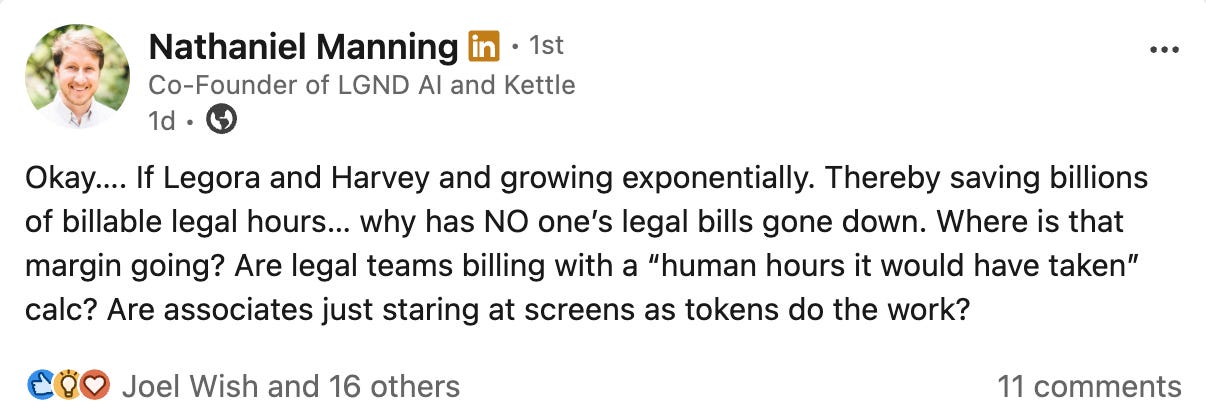
As technologies roll out, initial advantages go to incumbents who can adopt the new technologies for efficiency gains, and margin expansion. I’ve heard a number of friends say, “If companies like Harvey and Legora are growing so quickly, how come my law firm bills haven’t gone down?” If a lawyer is able to perform commoditized legal work in a fraction of the time, shouldn’t this hit billable hours, and therefore the cost for services? In the short run, this margin accrues to the incumbents.
But let’s take radiology as an example.
A decade ago many heralded the death of radiology as a field. The logic went as follows: radiologists predominately look at pictures of MRIs, AI driven image recognition and cognition was getting better and better, so therefore an image-heavy field like radiology would be one of the first things to disappear.
What happened, however, was two-fold:
AI impacted hardware (atoms): MRI machines became more powerful, faster, cheaper to build, manage and operate, and more came online
AI impacted software (bits): image-processing obviated the need for radiological review on rote and routine cases, and shifted their focus to the edge, where practitioner experience mattered, nuance and context were needed
These two impacts meant that more MRI machines became available to more people, and the number of radiologists needed to process the images went down. For a brief interregnum, image labs could have accrued margin due to being able to run MRI scans more cheaply, and perhaps with fewer doctors on staff as overhead.
But then something perhaps curious, or perhaps obvious, happened. New entrants flooded the market offering MRI scans for orders of magnitude cheaper prices, harvesting the delta between old price and new cost, and offered these services at prices that drastically undercut historical offerings. And because at these new price points there were entirely new use cases for MRIs, like preventative scans, demand skyrocketed, new companies were formed, further compressing margins in a race for user acquisition, and the total number of not just MRI machines and scans, but radiologists reviewing these scans, went through the roof.
This is a phenomena known as the Jevons Paradox, dating back to 1865. William Stanley Jevons first observed the phenomena with coal. Technological efficiencies lead to a rise in production capabilities, a reduction in price, and an ensuing expansion of demand. The very efficiencies thought to eliminate jobs create such a great expansion in production, and fall in price, that it’s net positive for both demand expansion and therefore the need for more human labor, not less. NPR recently did a great deep dive on exactly this phenomena as relates to the expansive effects of AI.
This three part movie will likely play out in legal, and many other industries:
AI affords advantages to incumbents who harvest new margins, and there’s a brief interregnum where incumbents continue to dominate, and prices don’t change (this is the valley of disbelief, where people think AI hasn’t changed much)
New entrants leveraging these new cost advantages undercut industry norms, and attack this new margin, closing the gap between price and cost
Prices for the same services fall, and there is net new demand for these services at new price points, probably leading to market expansion and growth
Both incumbent and new player may continue to exist, but because the incumbent’s fixed costs are likely commensurate with old price points, they’ll have a structural disadvantage to the new players who are AI-native, and don’t carry some of the same deadweight fixed costs, making them more nimble and immune from margin erosion.
Overall, like we saw with Prenuvo, Ezra (now Function Health), EverLab, Axo and many of the consumer-facing health companies offering preventative MRI scans at a fraction of the traditional costs, we’ll likely see new supercharged AI-native law firms who will be able to offer commensurate quality to a top-tier firm, at a fraction of the price. They’ll eat into those incumbent law firm margins and profits, drive the fee per service down, and in turn perhaps create net new market expansion.
At firms like Omar Haroun’s Eudia supercharging in-house counsel with AI tools, they’re providing an AI-native toolbox for in-house counsel to drastically slash legal budgets. While they still may pay premium dollar for white-shoe litigators, mainly for the optical threat of power against peers, commoditized legal will be a race to the bottom, with new entrants cutting into incumbent partner rate charts by being able to do comparable quality work at a fraction of the cost for clients.
Early AI efficiencies accrue to legacy incumbents. Net new AI-native players leverage new cost advantages to attack margin. Prices reduce and clear. Net demand increases for services, market expands, and net new jobs are likely created due to growth. Like was experienced with coal, with radiology, legal might be next. If my legal bills fell from $2,000 an hour to $200, I might actually ask more than 10x my demand. But this new value accrual won’t go to legacy players hoarding margin. It’ll go to new players, or those AI-native firms with the structural cost advantages to support it.
—
Scott Hartley is Co-Founder and General Partner at Everywhere Ventures, a $100 million-dollar early stage venture capital fund that has backed over 250 companies.
Special thanks to Omar Haroun at Eudia, and Michael Barone at Everywhere.
thanks Scott! do you distinguish between infrastructure-layer Jevons and application-layer Jevons? this matters for where founders should build.